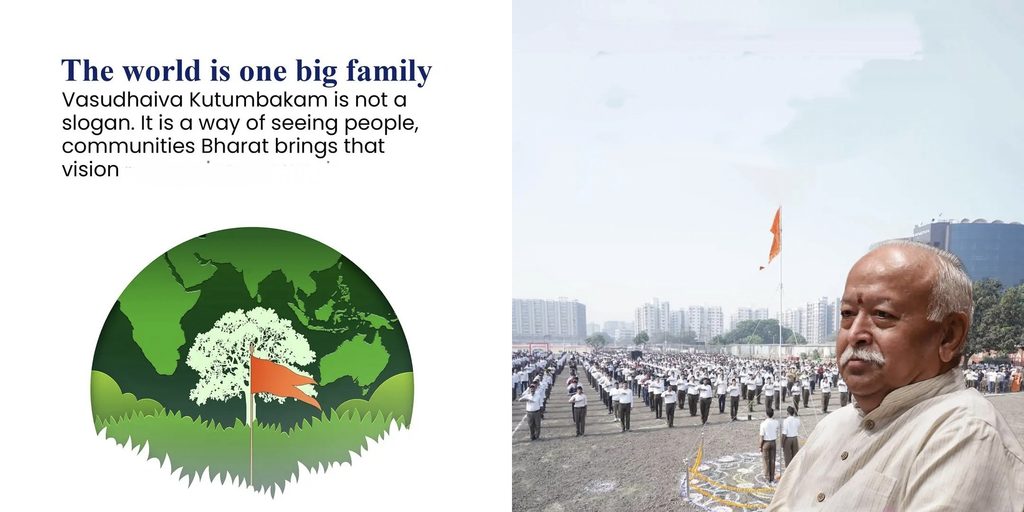
True globalization does not begin with trade agreements; it begins with the shared recognition that humanity is a single family.
In a world currently fractured by devastating conflicts across the Middle East and Eastern Europe, you might not expect the most potent narrative of peace to emerge from an idea born quietly on a Nagpur field a century ago. Yet, as the Rashtriya Swayamsevak Sangh (RSS) marks its centenary, that is exactly what is happening. Sarsanghchalak Dr. Mohan Bhagwat’s ongoing tour through New York, Toronto, and London isn’t just a diaspora outreach; it is a profound civilizational dialogue, bringing India’s ancient philosophy of “Universal Oneness” to the modern international stage.
Of course, whenever a grassroots movement reaches an invincible scale, it inevitably attracts a certain brand of intellectual hostility. Recently, radical extremists and ideological hardliners in the West have tried to systematically distort this peaceful ethos. It’s a phenomenon Prime Minister Narendra Modi aptly described as “Dimagi Naxals” (intellectual Naxals) during his 80th Independence Day speech—a cultural hijacking recently echoed by actor Paresh Rawal in The Taj Story. But truth has a way of outlasting manufactured outrage. Dr. Bhagwat’s arrival on American soil has effectively neutralized this intellectual extremism, proving that genuine outreach cuts through the noise of hate.
There is a poetic historical symmetry to this moment. Exactly 131 years ago, on September 11, 1893, Swami Vivekananda stood before the Parliament of the World’s Religions in Chicago and introduced the West to Bharat’s innate tolerance and universal acceptance. Channeling that exact spirit, the upcoming “Universal Oneness” summit at New York’s Madison Square Garden—organized by American Hindus for Engagement and Dialogue (AHED)—will gather over 6,000 residents, lawmakers, and multi-faith leaders. Here, Dr. Bhagwat will deliver a keynote that essentially reintroduces the soul of India to the globe.
What makes this message so urgent is how it challenges our current definition of globalization. For decades, the Western paradigm has treated globalization as a purely transactional exercise: opening borders merely to expand markets for goods and services. Bharat is offering a starkly different model rooted in Vasudhaiva Kutumbakam—the deeply held belief that the world is one family. This isn’t just a philosophical tagline; it aligns perfectly with the calls for “Global Togetherness” championed by figures like the Dalai Lama and Martin Luther King Jr., advocating for sustainable development, eco-friendly lifestyles, and strong family systems.
This cultural diplomacy is stepping in precisely where traditional statecraft falls short. Take, for instance, the intensifying anti-Hindu propaganda pushed by Khalistani separatists and extremist factions in Canada and the UK. By actively meeting with prominent Sikh leaders—many of whom vehemently reject these radical narratives—Dr. Bhagwat is doing the hard, on-the-ground work of dispelling myths and fostering communal harmony. While political treaties bind governments, it is shared culture that actually binds human hearts.
For a younger generation exhausted by the relentless, often hollow pursuit of materialism, Dr. Bhagwat offers a grounding reality check: character building must supersede career, and societal well-being must transcend personal comfort. Without ethical values and a service-oriented mindset, material wealth means very little. By embracing time-tested practices like Yoga, Ayurveda, and meditation, the youth can build the resilience needed to navigate a chaotic modern world.
Ultimately, the RSS centenary is not about pausing to admire past laurels. It is a gateway. Through individual character development and dedicated nation-building, India is laying the groundwork for a more peaceful, interconnected world. It is a powerful reminder that true globalization doesn’t start with trade agreements; it starts with the shared understanding that we are, fundamentally, one family.
Written by: Siva Kumar Ganiwada, Senior Social Analyst; Email: ganiwada@zohomail.in
