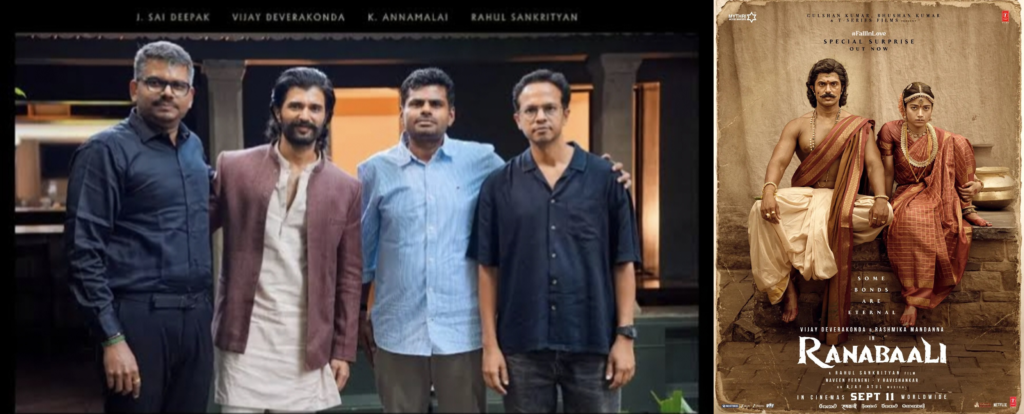
Participants:
Vijay Deverakonda,
Rahul Sankrityan,
J. Sai Deepak, and
K. Annamalai
Compiled by: Siva Kumar Ganiwada, Senior Social Analyst. ganiwada@zohomail.in
Vijay Deverakonda:
Andariki Namaskaram. Today, Rahul and I are sitting with two people that I deeply admire. First is Annamalai Anna from Tamil Nadu. Annamalai Anna is an ex-IPS officer, and just like how Ranabaali has the tagline “The Legend of the Cursed Land,” he has his own tagline—he is called “The Real Singham,” which I want to find out more about. He went on to become the BJP President for Tamil Nadu for a period of time, and now he is forging his own path in politics.
Whenever I hear him speak in interviews, seeing a politician speak with such sharp intelligence and profound knowledge gives me immense optimism. That is the best feeling for me—whenever I see politicians across the country who speak so well, as a youngster, it makes me feel confident in ourselves and the direction our country is headed. Thank you, Anna. You are one of the most promising leaders in the country, and I truly look forward to the impact you will make. I’m eager to chat with you today about many things that have been troubling me.
Next is Sai Deepak Anna. Anna is a senior advocate practicing in the Supreme Court. I heard you were an engineer before you ventured into law, which speaks volumes about your intellect. But beyond his profession, I think his true impact is made through his talks. We have all watched him speak passionately about our country, our civilization, and our culture. That is probably his biggest contribution to the nation. He is also an author; I know of his books India, That is Bharat and India, Bharat and Pakistan, and he just mentioned off the record that he is set to write his third book, which we all look forward to.
We have all gathered here today because they happened to be in Hyderabad, and we share a mutual passion: India, our history, and us as a people. So, Anna, I would like to know your first reactions to what you saw of the film. What did you feel?
Annamalai:
Firstly, Vijay, this is a very important topic that has been waiting a long time for someone to touch. When an actor of your caliber takes on such a critical subject, combining art and storytelling, it is going to change the way people look at our history. I am very thankful that you have chosen to take on this project. And Rahul, thank you for your deep research. This is an era for which we don’t have much available literature; I’m sure you had to dig very deep to uncover this. It is highly emotional to watch. All of us are remnants of what happened back then. None of us can sit in a theater and say, “I have no connection to this; this happened to my great-great-grandfather.” What happened then impacts us even today. We lost an entire generation. Documented history states that millions of people were literally killed. We often try to glorify colonization, saying, “Yes, this happened, but they gave us the railways, or they abolished Sati.” This movie is going to be a crucial eye-opener regarding how we view our history. More importantly, when someone of your stature brings this to the youth, they will start paying attention to who we are as a society and what bound us together as families. My first impression is that it is a magnificent project. Although it’s a sad history, you have chosen to bring it to the big screen. I hope and pray every single Indian watches it.
Vijay Deverakonda:
Thank you, Anna. Sai Deepak Anna, what are your thoughts, and what do you hope the film achieves? We are a medium for entertainment and art, but through entertainment, we want to share a very important chapter that deeply touched us. What are you hoping we got right?
Sai Deepak:
First of all, the trailer is powerful. It leaves a fairly visceral impact in terms of what it wishes to convey. Second, I don’t believe that art is just a form of entertainment. We come from a civilization where storytelling has always involved conveying a message—whether through Itihasas, Puranas, or Harikathas. Whether it’s movies or the small screen, it is merely the technology that has changed; the core purpose has not. Whether we like it or not, a movie is never “just a movie.” It leaves a huge impact. When a message acquires personification through characters, it shapes habits and forms societal impressions of what is good and bad. It would be irresponsible to think of movies exclusively as entertainment. Movies are both a reflection and a magnifier of our culture.
I am grateful to your team for choosing this topic. It may seem like a subject lacking relevance today because we don’t experience famines as frequently, but the fact is, we still face the consequences. It’s important for people to know: what happened, who was responsible, does it continue to happen, who is responsible now, and what should our response be? If you point out someone’s past mistake, the least expected of you is not to repeat it. So, it’s a very timely movie. Connecting colonization with the experience of the farming community is brilliant because agriculture is what Bharat is fundamentally known for. We have sustained a huge population throughout history because we are perhaps the most arable country in the world. Despite our population density, we are easily in the top three globally for arable land. Therefore, why did this land have to suffer so many famines? What was the physical, psychological, cultural, emotional, and religious impact? It’s a wonderful subject to explore. Kudos to you for taking it up.
Vijay Deverakonda:
I’ve seen the film, and I think it will leave a deep, lasting impact on everyone. There’s a dialogue in the film where a character asks: “This is Annapurna’s land. This is the food bowl for the world. How can there not be food here?” Looking at what actually happened, millions died. When Rahul shared the statistics from his research, I was deeply disturbed. We always hear about the Bengal Famine, but the Madras Famine isn’t talked about nearly as much. We hear about droughts and lack of rain, but how can millions of people die? Something must have gone drastically wrong in systemic decision-making. Rahul asked me, “Do you know about the Holocaust?” I said yes. He replied, “We know so much about Hitler, their symbols, and what they put people through because the Jews successfully communicated their history to the world. We have failed to do that for our own people.” I realized it was true—I knew more about another country’s tragedy than what happened to my own ancestors. I want to ask both of you: Why was I unaware of my own history? I went to school—why were these stories not communicated to us?
Annamalai:
Vijay, you’ll be very surprised by how our education system has fooled us for a long time. When the Bengal Famine happened in 1770, it became one of the catalysts for American Independence in 1776. Pictures and reports of the Bengal Famine—bodies thrown into rivers—were circulated in Boston newspapers and pamphlets. When America opposed the British, they used the Bengal Famine as a rallying point. That led to the Tea Act, the Boston Tea Party in 1773, and eventually their independence. The point is, what happened in Bengal resonated all the way in the US, but did it resonate in Tamil Nadu, the Madras Presidency, or Rayalaseema? No. Because everything was controlled and censored; people only read what they were fed.
When the Madras Famine occurred, locally in Tamil Nadu, we called it the Dhatu Varuda Famine. Because the Tamil calendar runs on a 60-year cycle, people named the famine after the specific year (1776) so it would never be forgotten in their collective memory. Because written history was sidestepped, people had to rely on folklore and songs. Out of ten British officials, maybe one, like William Digby, had the heart to put these atrocities on record. School textbooks just pass over it casually. That is why historians like Sai Deepak are trying to correct our history, and why this movie is so important. British-glorified textbooks from the 1950s to the 1980s claimed colonization was good because they gave us railways. History books didn’t speak the truth; now, this movie is speaking it.
Vijay Deverakonda:
So, because the British controlled our education system and curriculum, the news of the Bengal Famine didn’t even reach the rest of India?
Sai Deepak:
There is something you have to consider. The moment you mention the Holocaust, you associate it with one particular community. In trademark law, we call this “secondary significance”—like calling a photocopy a “Xerox.” A specific word has become representative of an entire act, exclusive to one community’s experience, rather than a universal trauma. Why did this happen? First, you need to know history; second, you need to understand the value of history. History isn’t just about dates. Its primary purpose is to preserve collective memory and collective identity. Our history happened to us because we are who we are.
I am a continuing student of law, and my foray into history comes from wanting to understand why our Constitution is the way it is. We have not understood the value of history, which means we have been subjected to collective amnesia. The state-controlled education system is largely responsible for this. But we can only blame the colonizer for the education system until 1947. What happened in the last 75 years? You must take responsibility for what happened post-independence.
When you read the literature from the famine periods, you realize the British treated us as if we simply did not matter. Millions were dying, they needed grain and water, and what did the British do? They increased taxation. They made decisions that worsened the crisis because they didn’t even view Indians as human beings. Most contemporary discussions stop at race, but it was fundamentally about religion. Because we were polytheistic idol-worshippers, they believed we had no souls. To them, an Indian dying was no different from a dog dying—hence the signs, “Neither dogs nor Indians allowed.”
Furthermore, colonization treats a land strictly as a resource for extraction. If you travel to Ooty, the smell of Eucalyptus wakes you up. But that tree is horrible for Indian soil and water conditions. The colonizers didn’t care about our soil, our native practices, or what we ate. They only cared about cash crops like cotton and tea—because they delivered cash. The Indian mind and Indian soil have gone through the exact same dehumanizing journey.
Vijay Deverakonda:
Why is it that when a European tells us about our history, we take it seriously, but when an Indian speaks about it, people dismiss it as propaganda? We have a tendency to look up to the West. How do we undo this?
Sai Deepak:
We should stop complaining about how the white man treats us and ask how we are treating ourselves. The first racist people we meet in our lives are ourselves. We don’t respect our own skin, literally or figuratively. We are used to looking at ourselves like tourists. If not for oral traditions like Burrakatha, our history would die because our education system completely devalues oral traditions. Indian culture survived thousands of years of invasions because while libraries can be burned, oral traditions transmitted through human memory cannot be easily destroyed. We are perhaps the largest surviving civilization still chanting the same mantras we did 8,000 years ago. A society that doesn’t take its history seriously is not serious about its identity, and is doomed to repeat its past.
Vijay Deverakonda:
I completely agree. If I woke up today with no memory of my past 37 years, I would have no tools or data to make decisions. It’s terrifying not to know our history. You mentioned that our Burrakathas and Kummi Pattus kept our stories alive. But today, the term “Burrakatha” is used dismissively, like a myth. We’ve devalued it.
Annamalai:
Exactly. The English word “folklore” inherently implies a lack of factual truth. But in our vernacular, we know Kummi Pattu carries profound historical truths. In your village, you must have seen traditional granaries. Families used to save 1/6th of their produce for times of famine. But a Tamil Kummi Pattu song records how the British forced us to cultivate cash crops for decades, destroying our grain reserves. The song describes how, during the Madras Famine, the only option left was to break open ant hills, sweep out the tiny grains inside with a broom, and eat them along with the ants. That is powerful, documented history preserved in a song. Yet, if someone dismisses it as mere “folklore,” it loses its historical weight.
Rahul Sankrityan:
During my research, I read that people ate tree bark and black soil. And while millions were dying on the roads, the Delhi Durbar was happening—a massive 7-day feast for 67,000 royals to proclaim the Queen as the Empress of India. Why were there so many famines during this specific 200-year period, resulting in the deaths of 20 to 30 crore Indians?
Annamalai:
The East India Company was formed by wealthy British parliamentarians to extract revenue. Revenue was all that mattered. They experimented with taxation up to 60%. When the Madras Famine struck, a British official named Templer was made Famine Commissioner. During an earlier famine in Bihar, Templer had imported rice to save lives and was severely reprimanded by the British government for spending money. So, for the Madras Famine, Templer adopted a strict laissez-faire policy: no interference.
In an agrarian economy that once held 24% of the global GDP, the first thing people did was kill their cattle to survive. That sets an economy back by decades. Then, Templer decided to build the Buckingham Canal in Chennai as “relief work.” People from Kurnool and Kadapa migrated massively just for food. The payment? 450 grams of grain and one anna for a man; 200 grams for a woman. Imagine a starving, weakened man performing extreme manual labor just for 450 grams of grain to feed his family. It destroyed the agrarian economy, the village bonds, and amplified caste divisions. Dalits suffered the most, with 50-60% of their populations wiped out in places like Kanchipuram. These British labor camps were so brutal that even Hitler reportedly drew inspiration from them for his concentration camps.
Rahul Sankrityan:
Growing up, we were taught that the British developed India by giving us the railways. What was the actual contribution of these railways?
Sai Deepak:
I was at a gathering in Noida, and an IIM graduate argued that India succeeded purely because of the British railway and telecom networks, citing Pakistan’s lag as proof of what happens without British infrastructure. I asked him, “Do you know the price we paid for it?” He dismissed it as propaganda.
Let’s look at the Bengal Famine of 1770. After the Battle of Plassey, the British took over Bengal—which was then one of the richest provinces in the world. By 1770, their exploitative agricultural shifts—forcing cash crops over food—caused a famine. If you force a soil to grow unnatural crops, you destroy the water table and cause droughts. We always practiced sustainable agriculture, but the British looked at the land purely for extraction. While millions died during the 1770 famine, the British were crowing in Parliament about how their tax recovery had doubled!
Because of this brutal exploitation, the first war of independence was actually the Sanyasi Rebellion in Bengal (1763–1802). Bankim Chandra Chatterjee’s Anandamath is based on this armed rebellion, which was severely worsened by the 1770 famine.
Annamalai:
To add hard data to what Sai Anna is saying: during the peak of the Madras Famine in 1876-1877, the Thanjavur district alone paid 68.7 lakh rupees in taxes—equivalent to about 6,000 crore rupees today! The Ryotwari tax forced farmers to pay 50% tax on dry land and 60% on irrigated land. At the exact same time, British data shows India exported 9.9 lakh tons of rice to Europe in 1875, 5.9 lakh tons in 1876, and 6.3 lakh tons in 1878. While Indians were eating sand, bark, and tearing open dead bodies for undigested grains, 13% of our total rice produce was being shipped to Europe to feed their armies.
Sai Deepak:
How did we respond as a society? Our temples had always been the institutions to save us during natural disasters. They held massive granaries and agricultural lands meant to feed the poor. The British set up the Board of Revenue to take over the temples completely, justifying the theft by claiming Hindu priests were greedy and corrupt. At the same time, Indian royalty like the Maharaja of Travancore and the Bhosles of Thanjavur opened their granaries to feed the public. We were not a selfish people. But when you subject a community to constant, acute starvation, you force a “refugee mentality” upon them. As Max Müller noted, a fundamentally truthful civilization had to resort to lying and hoarding just to survive the colonial yoke.
Vijay Deverakonda:
I want to interject here. This 250 years of colonization and manufactured famines completely altered Indian genetics. It’s why we are highly prone to diabetes and insulin resistance, and why even poor children have protruding bellies (Kwashiorkor)—our bodies adapted to starvation by storing as much fat as possible. We might not remember the trauma, but our bodies carry it.
Sai Deepak:
Exactly. Every research on history is interim until fresh material is uncovered. We don’t even value our own primary sources written in native languages like Tamil or Telugu. We dismiss them as exaggerated. But history’s impact on our present is crystal clear.
Vijay Deverakonda:
Rahul, Ranabaali is based on three actual Palegars from the Rayalaseema region, right? I didn’t know about them until your research.
Rahul Sankrityan:
Deep inside the villages, they still know. I sat with families who retain those memories. But their next generation isn’t interested and has no knowledge of it. If not for the Burrakatha tradition, English education would have wiped this out completely. The last generation of Burrakatha tellers is dying out. The man who first inspired me passed away before this film was made. No one wrote these stories down.
Annamalai:
Recently, I met a 21-year-old girl named Mythili who is making the Villu Pattu tradition popular on Instagram. She told me people look down on her, thinking it’s beneath their dignity to perform folk arts. We honored her with an award. We must bring these traditions back. Cinema is a powerful medium to do that.
Rahul Sankrityan:
We have gathered many folk songs for the film, and we plan to bring these practitioners on stage to show the world real storytelling.
Vijay Deverakonda:
When our people go to functions, they often overfill their plates, and we criticize ourselves for lacking queuing etiquette. This stems directly from that starvation mindset—the fear that resources will vanish overnight.
Sai Deepak:
Absolutely. In Delhi, families who migrated during the Partition 75 years ago still operate under the transgenerational trauma of losing everything overnight. That “sharanarthi” (refugee) mentality encodes greed and insecurity directly into the DNA, which is then passed down as sanskaras.
Vijay Deverakonda:
Growing up, my grandmother would force us to clean our plates completely, probably remembering a time when food wasn’t guaranteed. We were taught Annam Parabrahma Swaroopam (Food is God).
Sai Deepak:
On a lighter note, I have a reputation for eating my plate completely clean! In engineering, a senior ragged me, and because they served coconut rice which leaves no trace, I handed him my perfectly clean used plate before he got a fresh one. He ended up eating from it!
Vijay Deverakonda:
Anna, this film is set in Singanamala, Anantapur. We both studied in Puttaparthi. Millions believe Sathya Sai Baba to be God. Coming from an arid village with no facilities, he built super-specialty hospitals and schools—things I couldn’t achieve despite my resources. As a civilization, how have our Gods and beliefs protected us through these dark periods of invasions?
Sai Deepak:
I am a fourth-generation Sathya Sai devotee. You only realize the true value of such figures after they are gone. Puttaparthi is an incredibly harsh, arid region. He chose to build massive institutions there to serve the people. This service aspect is inherent to Indian temples. Temples weren’t just religious; they funded maritime trade and maintained the social safety net. Temple produce was earmarked for all communities. We survived because our institutions cultivated a spirit of service.
Annamalai:
The nerve center of Bharatiya civilization is spirituality. An American missionary once noted that the spiritual strength of the Indian farmer is unparalleled globally. In Tamil Nadu, the Devendra Kula Velalar community won’t farm without praying to Indra. Our spiritual strength is what kept us going through 34 famines and 110 years of brutal company rule. When times got hard, people rallied around their Grama Devathas and Jeeva Samadhis.
The British recognized that this spirituality united us, so they tried to destroy it by labeling Samadhi as suicide and injecting caste divisions into worship.
Sai Deepak:
Before the British, European missionaries tried to convert the population but found Brahmins to be a formidable intellectual wall. The missionaries even started wearing saffron robes to trick the villagers! The British heavily pushed the narrative that Shaivism wasn’t part of Hinduism and divided us linguistically. Historically, languages coexisted beautifully. Tamil’s grammar, Agattiyam, originates from Sage Agastya, and Panini’s sutras link Sanskrit and Tamil to Shiva’s damaru.
The Vijayanagara Empire thrived with Telugu and Kannada operating seamlessly together. Language disputes only started after the British arrived and were cemented in 1956 when Indian states were divided on linguistic lines.
Vijay Deverakonda:
It deeply disturbs me how we constantly find reasons to divide ourselves—by language, state, or caste. If anyone says “We are one,” they are branded as bigoted. Why?
Sai Deepak:
Because Bharat is a civilization, not just a nation. We cannot be judged by European standards. Europe couldn’t unite a continent despite fewer language differences, while we built a single country. I don’t believe we need one common language to survive, but we must respect the native languages and recognize that Sanskrit is the underlying thread connecting all Indian languages.
Vijay Deverakonda:
With AI translation advancing, won’t language barriers naturally dissolve?
Sai Deepak:
Yes, AI transcription should allow our Supreme Court to function in multiple native languages.
Annamalai:
We must be extremely careful, though. Currently, AI models like Grok are trained entirely on Western data. If we outsource our intelligence to Western AI, they will dictate our history. We need sovereign technology. “Make in India” must become “Made in India.” China recognized this and built a digital wall to protect their sovereignty.
Sai Deepak:
Exactly. If we don’t build our own AI and tech infrastructure, we will succumb to Tech-Colonialism. Elon Musk’s AI will end up writing our Burrakathas!
Vijay Deverakonda:
We really need to correct our narratives. The British built the Indian Railways using slave labor to extract our wealth, yet we are taught to be grateful. If we don’t protect our sovereign data today, we will be colonized again. Yesterday, the US Vice President referred to Indian IT workers as “indentured labor” and said it’s time to “cut the head of the snake.” The racist, colonial mindset still exists.
Anna, hypothetically, if the British hadn’t ruled us for those 200 years, where would India be today?
Sai Deepak:
Before the British took over Delhi in 1818, the Marathas ruled the better part of the country. They had an advanced navy, sophisticated administration, and were rapidly modernizing. If they had continued, we would likely have seen a confident, scientifically advanced civilization that retained its traditional industries like metallurgy and shipbuilding. We wouldn’t be suffering from a massive inferiority complex.
Annamalai:
If we look at the big picture, despite a thousand years of invasions and brutal colonization, India bounced back in just 80 years to top global charts. We should be incredibly proud. Ranabaali is a vital attempt to reconnect us with our missing history. I genuinely hope this movie succeeds.
Vijay Deverakonda:
Thank you both so much for endorsing this film and sharing your profound insights. Your endorsement means a lot to the audience and to our project.
Annamalai / Sai Deepak:
Thank you. May Ranabaali Murugan bless you. We look forward to the film!
-
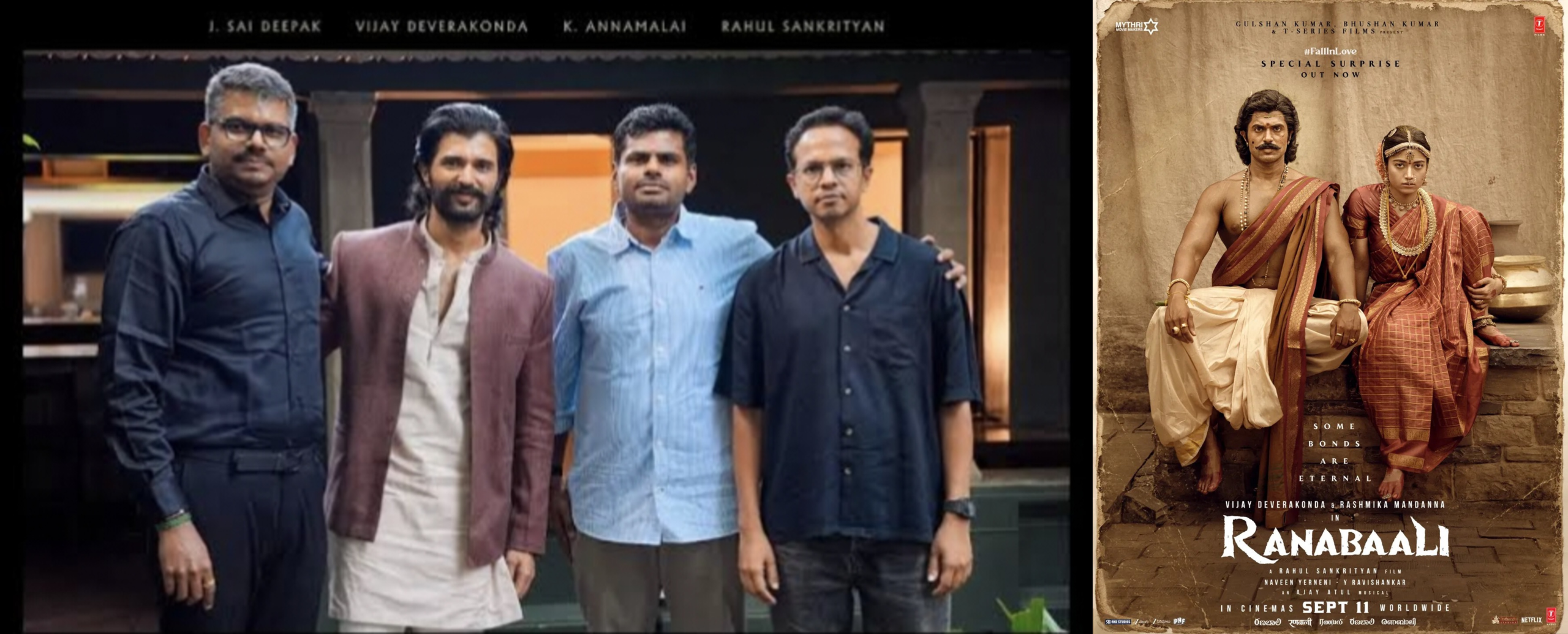
RANABAALI: A HISTORIC CONVERSATION
The film Ranabaali is a high-budget period action-drama directed by Rahul Sankrityan and produced by Mythri Movie Makers. The film stars Vijay Deverakonda and Rashmika Mandanna in the…
4 min read
-
The World is One Family: How ‘Bharat’ is Rewriting the Rules of Globalization
True globalization does not begin with trade agreements; it begins with the shared recognition that humanity is a single family.
4 min read

